 08452 30 40 30




The Helium Shortage: Why Laboratories Must Act Now
Helium has long been the carrier gas of choice in gas chromatography (GC). However, supplies are diminishing globally, prices are rising, and availability is becoming uncertain. This creates a significant risk for laboratories that depend on consistent performance and uptime.
Impact on Laboratories
Helium is not only used in analytical laboratories but is also critical in high-priority applications such as MRI scanners, semiconductor manufacturing, aerospace systems, and fibre optics. Due to this, gas chromatography applications are often deprioritised during shortages, leading to rationing and inconsistent availability for laboratories.
For laboratories, this means rising operational costs and potential disruption to workflows. Price increases show no sign of slowing, and supply constraints can directly impact output, timelines, and efficiency. The question is no longer if laboratories should move away from helium, but when.
Hydrogen: The Practical Alternative
Among available carrier gases, hydrogen stands out as the most effective alternative. It offers faster analysis times, greater efficiency at higher velocities, and comparable or improved performance over helium. This allows laboratories to increase productivity without compromising analytical quality.
In addition, hydrogen can often enable separations at lower oven temperatures, which contributes to extended column lifetime and reduced thermal stress on analytical systems.
Safety Without Compromise
Concerns about hydrogen safety are common, but modern systems incorporate multiple safeguards such as leak detection, automatic shutdowns, and controlled low-pressure delivery. With today’s technology, hydrogen is a safe and reliable choice for GC and GC/MS applications.
Hydrogen disperses rapidly in air approximately twice as fast as helium, significantly reducing the likelihood of accumulation. In modern GC systems, electronic pressure control (EPC) and pneumatic pressure control (PPC) systems continuously monitor gas flow and automatically shut down the instrument if a leak is detected. Additional safeguards such as hydrogen sensors, automatic leak testing, and flow limiters further reduce risk.
Even in worst-case scenarios, such as a column leak inside the oven, it would take a prolonged period to reach flammable concentrations, and built-in safety systems are designed to intervene long before this occurs.
Why In-House Hydrogen Generation Makes Sense
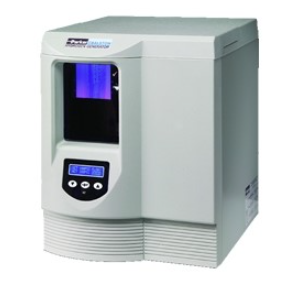
The real advantage of switching to hydrogen comes from generating it on-site. In-house generators significantly reduce costs, provide a continuous 24/7 gas supply, enhance safety by eliminating high-pressure cylinders, and improve convenience by removing manual handling and storage requirements.
Cost comparisons highlight the economic advantage of in-house hydrogen generation. Typical annual costs for hydrogen generation systems are a fraction of those associated with helium cylinders, which include not only gas purchase but also rental, transport, handling, and administrative costs. In addition to cost savings, on-site generation eliminates downtime associated with cylinder replacement and ensures uninterrupted laboratory operation.
The Smarter Choice for Modern Laboratories
Modern hydrogen generators provide ultra-high purity gas, reliable performance, minimal maintenance, and integrated safety features. By adopting this technology, laboratories gain operational independence, improved analytical performance, and long-term cost stability.
Technology advancement
Modern hydrogen generators utilise Proton Exchange Membrane (PEM) technology to produce ultra-high purity hydrogen (up to 99.99995%) from deionised water and electricity. These systems operate at low pressure with minimal stored gas volume, significantly improving safety compared to high-pressure cylinders. Advanced control systems allow for stable flow rates, remote monitoring, and integration with laboratory workflows.
Analytical Performance
Real-world applications have shown the effectiveness of hydrogen across a range of analytical methods. In GC/MS analysis of phenols, hydrogen has been shown to reduce run times by over 1.5 minutes while keeping comparable calibration accuracy. In PCB analysis, run times can be reduced by approximately 3 minutes, and in PAH analysis, time savings of over 5 minutes have been seen. These improvements are achieved alongside enhanced sensitivity, reduced peak tailing, and improved baseline resolution.
Transitioning
Transitioning from helium to hydrogen is a structured and manageable process. Key steps include verifying system integrity, recording existing analytical parameters, installing hydrogen supply lines or generators, adjusting flow rates based on hydrogen properties, and recalibrating analytical methods. Many modern GC and GC/MS systems include software tools to assist with method conversion, making the transition more efficient and reliable.
The helium shortage represents a long-term shift, not a temporary issue. Laboratories that act now can protect themselves from rising costs, supply disruptions, and inefficiencies. Hydrogen generation offers a safer, faster, and more cost-effective solution for gas chromatography. Cut costs and simplify your workflow by investing in an in-house hydrogen generator today.
Contact our sales team belowtoday to discuss your requirements, ask any questions, and discover how we can help you transition away from helium with confidence.
|
To find out more: |